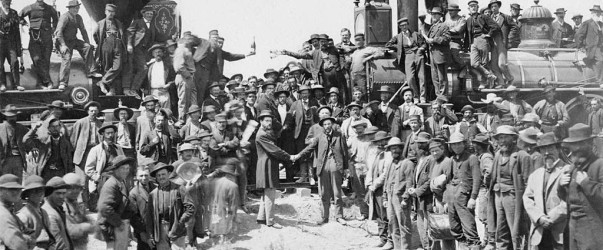
In 1869, the driving of a golden spike at Promontory Summit, Utah marked the completion of one of America's greatest engineering marvels - the Transcontinental Railroad. This remarkable feat of 19th century innovation slashed cross-country travel time from months to days, fueled explosive economic growth, and forever transformed how Americans understood their vast nation.
Before 1869, traveling across the United States was an arduous journey that took months by wagon or weeks by ship around South America. This physical disconnection between East and West created not just logistical challenges but profound cultural and economic divides. The completion of the Transcontinental Railroad would forever change America's relationship with distance, time, and its own geography.
The 1,912-mile iron path connecting Omaha to Sacramento stands as one of America's most ambitious 19th-century achievements, a project of such magnitude that many doubted it could be accomplished. Yet through political will, engineering innovation, immigrant labor, and immense sacrifice, the nation was physically united in a way previously unimaginable.
The Vision of Connecting a Nation
The concept of a transcontinental railroad emerged decades before construction began. As early as the 1830s, visionaries like Asa Whitney proposed building a railroad to the Pacific. However, the idea gained real momentum after the 1848 California Gold Rush and the acquisition of western territories from Mexico.
In 1862, with Southern states absent from Congress during the Civil War, President Abraham Lincoln signed the Pacific Railway Act, authorizing the monumental project and providing government bonds and land grants to finance it. The legislation established two companies to build the railroad: the Union Pacific, working westward from Omaha, Nebraska, and the Central Pacific, building eastward from Sacramento, California.

Lincoln saw the railroad as essential not just for commerce but for preserving the Union itself. "There is nothing more important before the nation," he declared, understanding that physical connection would strengthen political bonds during America's most divided era.
The Race Across the Continent
Construction began in 1863, transforming into a competitive race between the two companies. Each mile completed meant more government subsidies and land, creating powerful incentives to build quickly. The Union Pacific faced relatively flat terrain across the Great Plains but had to contend with hostile Native American tribes protecting their territories from encroachment.
Meanwhile, the Central Pacific confronted the Sierra Nevada mountains, where workers blasted 15 tunnels through solid granite and built precarious trestles over deep ravines. In winter, crews battled 40-foot snowdrifts; in summer, they endured scorching heat. On their best day, Central Pacific workers laid 10 miles and 56 feet of track in just 12 hours - a record that still stands today.

The race intensified as the lines approached each other in Utah Territory. The companies duplicated track for miles, grading parallel roadbeds as they competed for the maximum government payout before Congress finally mandated they agree on a meeting point at Promontory Summit.
The Immigrant Labor Force
The railroad's construction relied heavily on immigrant labor. The Central Pacific employed over 12,000 Chinese laborers, comprising about 90% of its workforce. These workers, primarily young men who had fled poverty and political unrest in China, proved exceptionally skilled and determined despite facing dangerous conditions and racial discrimination.
The Chinese workers received lower wages than their white counterparts and were often assigned the most perilous tasks, including handling explosive nitroglycerin to blast through mountains. Despite these challenges, they became known for their exceptional efficiency and engineering capabilities.
The Union Pacific, meanwhile, employed many Irish immigrants, Civil War veterans, and freed slaves. These diverse workforces represented America's changing demographics and the crucial role of immigration in the nation's development.
The Golden Spike Moment
On May 10, 1869, at Promontory Summit in Utah Territory, the two railroad lines finally met. Central Pacific's Jupiter locomotive faced Union Pacific's No. 119 as railroad executives Leland Stanford and Thomas Durant prepared for the ceremonial driving of the final spike.
The Golden Spike ceremony was one of America's first national media events. Telegraph wires were connected to the spike itself, allowing the final hammer strike to be transmitted instantly to cities nationwide, where waiting cannons were fired in celebration. The spike bore the inscription: "May God continue the unity of our Country as this Railroad unites the two great Oceans of the world."

While celebratory, the moment was also deeply symbolic - the physical unification of a country still healing from civil war. The nation was now bound not just by political principles but by steel rails spanning its vast geography.
Economic Impacts
The economic transformation brought by the railroad was immediate and profound. Travel time from New York to San Francisco plummeted from six months to just one week. Freight costs dropped dramatically - shipping goods from the East Coast to California became 85% cheaper by rail than by previous methods.
This transportation revolution accelerated America's industrialization. Eastern manufacturers gained access to western resources and new markets. Agricultural production expanded as farmers could ship perishable goods nationwide. Cities along the route - Chicago, Omaha, Denver, Salt Lake City - grew explosively as transportation hubs.
The railroad companies became America's first modern corporations, pioneering management techniques and financial instruments still used today. They also transformed land ownership patterns through their government-granted land holdings, which they sold to settlers and developers, spurring western migration.
Social and Cultural Transformation
Beyond economics, the railroad fundamentally altered Americans' perception of their country. What had been abstract geography in most citizens' minds became accessible reality. Tourism to the West flourished as the wealthy could now comfortably visit natural wonders like Yellowstone and the Grand Canyon.
The railroad standardized time in America. Before its completion, towns set their own local time based on the sun's position. The coordination of train schedules necessitated standardized time zones, which were formally adopted in 1883 by the railroad companies before becoming federal law.
Mail delivery accelerated dramatically, improving communication nationwide. This new connectivity facilitated cultural exchange between regions previously isolated from one another, contributing to a more unified national identity despite regional differences.
Environmental and Native American Impact
The railroad's construction and operation had significant environmental consequences. Forests were cleared for ties and trestles, with the Union Pacific alone using 300,000 trees. Coal mining expanded dramatically to fuel locomotives. The Great Plains ecosystem was forever altered as the railroad facilitated the near-extinction of the American bison, which were hunted from train windows and harvested for their hides and bones.
For Native Americans, the railroad accelerated the loss of their lands and traditional ways of life. The Iron Horse, as many tribes called the locomotive, brought waves of settlers, soldiers, and hunters into territories previously beyond easy reach. Treaties were broken as pressure for land intensified, leading to increased conflicts and the forced relocation of many tribes to reservations.
The Transcontinental Railroad thus represented progress for the expanding nation but dispossession for its original inhabitants - a complex legacy that continues to resonate in discussions about American history.
Legacy in Modern America
Today, much of the original transcontinental route remains in use as part of the modern American rail network, though passenger service has diminished in favor of freight. The Golden Spike National Historical Park in Utah preserves the meeting point of the two original lines, where visitors can see replicas of the Jupiter and No. 119 locomotives.
The railroad's completion marked America's emergence as a continental power capable of massive infrastructure projects. It established a pattern of government partnership with private enterprise for national development that would be repeated with the Interstate Highway System and the internet.

Perhaps most importantly, the Transcontinental Railroad demonstrated that Americans could accomplish seemingly impossible goals through determination and collective effort. It stands as a testament to both the nation's capacity for innovation and its ability to reinvent itself through technological achievement - even as we continue to reckon with the complex social and environmental consequences of such transformative progress.
Frequently Asked Questions About The Transcontinental Railroad: How 1,912 Miles of Steel Changed America Forever
Why was the Transcontinental Railroad built?
The railroad was built to connect the eastern and western United States, reducing travel time from months to days. It was championed to strengthen national unity after the Civil War, facilitate westward expansion, improve military logistics, and boost economic development by enabling efficient cross-country trade and transportation of goods and people.
How did the Transcontinental Railroad change America?
The railroad revolutionized America by drastically reducing travel times, accelerating western settlement, enabling national markets for goods, stimulating industrial growth, standardizing time zones, facilitating mail delivery, transforming land values, promoting tourism to western natural wonders, and creating a more integrated national identity. It also profoundly impacted Native American societies and western ecosystems.
Who built the Transcontinental Railroad?
The Transcontinental Railroad was built primarily by immigrant laborers. The Central Pacific relied heavily on approximately 12,000 Chinese workers (about 90% of its workforce), while the Union Pacific employed many Irish immigrants, Civil War veterans, former slaves, and some Mormon workers. These diverse crews accomplished extraordinary engineering feats despite dangerous working conditions, harsh weather, and limited technology.
What was the Golden Spike Ceremony?
The Golden Spike Ceremony on May 10, 1869, at Promontory Summit, Utah, marked the completion of the Transcontinental Railroad. Central Pacific's Jupiter and Union Pacific's No. 119 locomotives faced each other as Leland Stanford drove a final golden spike connecting the railways. The event was transmitted live via telegraph to celebrations nationwide and symbolized the physical unification of America after the Civil War.
What challenges were faced in building the railroad?
Builders faced enormous challenges including harsh weather (blizzards in the Sierras, scorching heat in deserts), formidable geography requiring extensive tunneling through mountains and bridging across ravines, limited construction technology, logistical difficulties transporting materials, worker shortages, hostile encounters with Native American tribes protecting their lands, disease, and financial obstacles including corruption scandals.
How did the railroad affect Native American communities?
The railroad had devastating impacts on Native American communities by accelerating white settlement of western territories, contributing to the near-extinction of buffalo (a key resource for Plains tribes), enabling military campaigns against tribes, violating existing treaties, disrupting traditional migration patterns and hunting grounds, and ultimately forcing many tribes onto reservations as their territories were increasingly fragmented by rail lines and new settlements.


