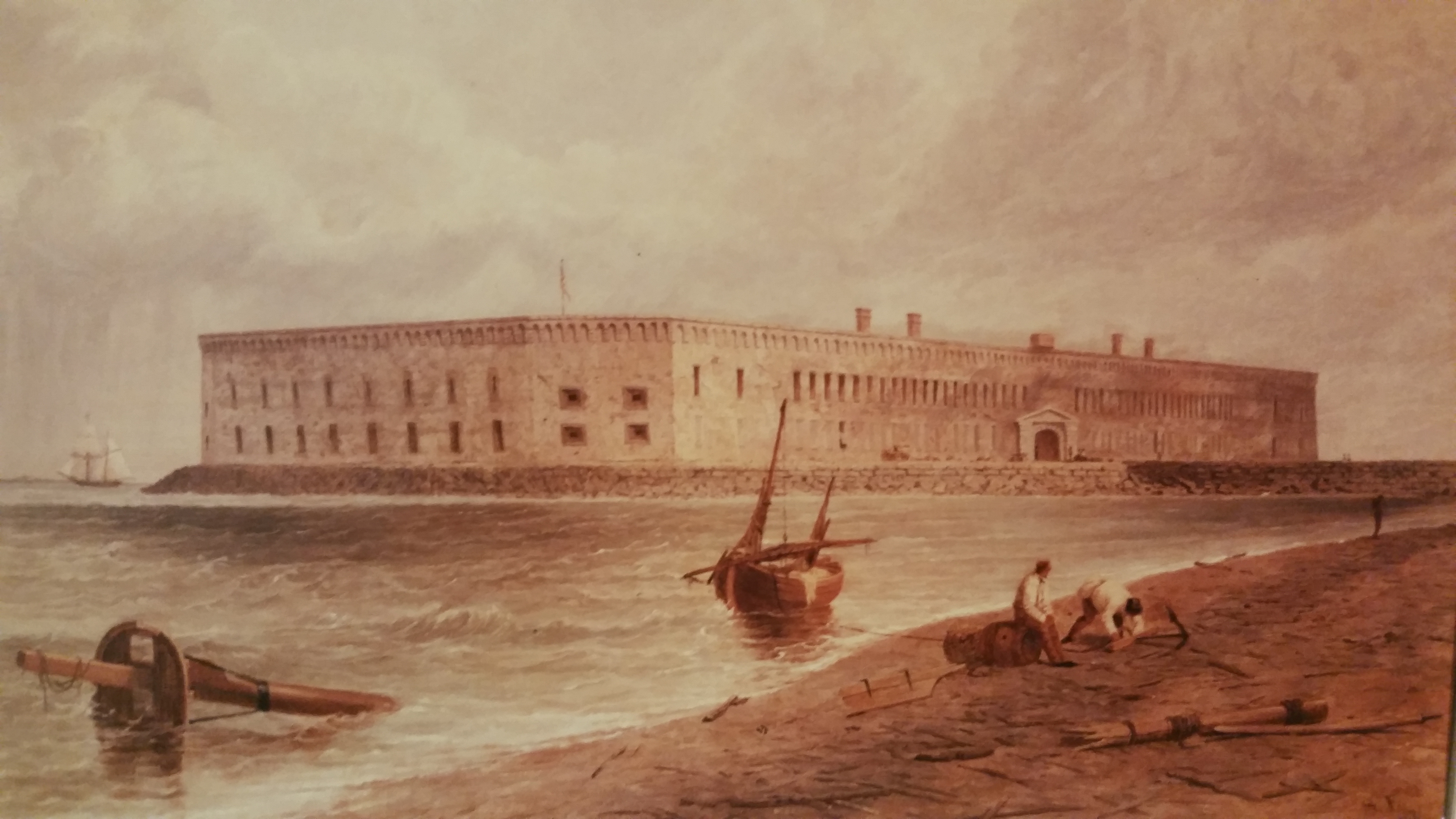
Fort Sumter, a sea fort in Charleston Harbor, South Carolina, became the stage for the opening act of the American Civil War on April 12, 1861. What made this particular fort the powder keg that ignited America's bloodiest conflict? The answer lies in a perfect storm of political calculation, symbolic importance, and strategic military considerations.
On the morning of April 12, 1861, the first shell arced through the dawn sky over Charleston Harbor and exploded above Fort Sumter. This moment marked not just a military engagement but the beginning of the American Civil War - a conflict that would claim over 600,000 lives and fundamentally transform the nation. Why did this obscure coastal fortification become the flashpoint that ignited America's bloodiest conflict?
The selection of Fort Sumter as the site where the Civil War began wasn't random chance, but rather the culmination of political tensions, strategic calculations, and competing claims of sovereignty that had been building for decades. Understanding why the war started here offers crucial insight into the complex forces that drove Americans to take up arms against one another.
Fort Sumter's Strategic Significance
Fort Sumter occupied a commanding position at the entrance to Charleston Harbor, South Carolina. Built after the War of 1812 as part of a coastal defense system, the fort was unfinished but militarily significant when South Carolina seceded from the Union in December 1860.
Several factors made Sumter uniquely important:
- It controlled access to Charleston, one of the South's most vital ports
- It represented federal authority within a state that had declared independence
- Its island location made it defensible but also isolated Union troops
- South Carolina viewed it as sovereign territory now unlawfully occupied
As one of the few remaining federal outposts in Confederate territory, Sumter became a powerful symbol for both sides. For the South, it represented Northern occupation of Southern soil. For the North, it embodied the Union's refusal to recognize secession as legal.

Lincoln, Buchanan, and Fort Policy
The Fort Sumter crisis developed during the precarious presidential transition from James Buchanan to Abraham Lincoln. Buchanan, a Democrat sympathetic to Southern concerns, had adopted a passive policy toward secession, arguing he lacked constitutional authority to stop it.
When Major Robert Anderson, commander of federal forces in Charleston, secretly moved his small garrison from the indefensible Fort Moultrie to Fort Sumter on December 26, 1860, he created a dilemma. Buchanan refused Southern demands to evacuate the fort but also refused to reinforce it significantly, leaving the problem for Lincoln.
Upon his inauguration on March 4, 1861, Lincoln inherited this powder keg. He faced an impossible choice:
- Abandon the fort: This would legitimize secession and potentially lead to the dissolution of the Union
- Reinforce the fort: This could be perceived as an act of aggression, potentially forcing the South to fire first
- Maintain the status quo: This would only delay the inevitable as supplies at the fort dwindled
Lincoln chose a middle path that would prove strategically brilliant. He announced plans to resupply the fort with provisions only, not weapons or troops. This put Confederate leaders in the position of either allowing the fort to remain in Union hands indefinitely or initiating hostilities.
The Confederate Ultimatum
Jefferson Davis and the Confederate government faced their own dilemma. The presence of a Union fort controlling Charleston Harbor was militarily unacceptable and politically humiliating for the new Confederate government trying to assert its legitimacy.
Confederate Secretary of War Leroy Walker instructed General P.G.T. Beauregard to demand the fort's surrender. On April 11, 1861, Beauregard sent representatives to deliver an ultimatum to Major Anderson: evacuate or face bombardment.
Anderson, low on supplies and with only 85 men, replied that he would evacuate by April 15 if he received no supplies or instructions from Washington. This wasn't sufficient for the Confederates, who knew Lincoln's relief expedition was already en route. At 3:20 a.m. on April 12, Confederate representatives informed Anderson they would open fire in one hour.
The decision to attack rather than wait for the fort to be starved into submission was driven by:
- Political pressure to demonstrate Confederate resolve
- Fear that allowing resupply would establish a precedent
- Concern about losing the initiative in the conflict
- The need to solidify support in other Southern states
The First Shots Fired
At 4:30 a.m. on April 12, 1861, Confederate batteries opened fire on Fort Sumter. Edmund Ruffin, an elderly Virginia secessionist, reportedly fired one of the first shots - a moment that became emblematic of the South's determination.
The bombardment continued for 34 hours. Although no one was killed during the actual battle (one Union soldier would die in an accidental explosion during the surrender ceremony), the sustained attack made it clear this was no minor skirmish but the beginning of war.
Major Anderson, recognizing the hopelessness of his position and with the fort on fire, surrendered on April 13. The Confederate victory was immediate but ultimately pyrrhic. By firing first, the South had handed Lincoln exactly what he needed: an act of aggression against federal property that would rally Northern support for military action.

The Aftermath and Symbolic Impact
The fall of Fort Sumter transformed the secession crisis from a political dispute into an armed conflict. Lincoln immediately called for 75,000 volunteers to suppress the rebellion, and four more states (Virginia, North Carolina, Tennessee, and Arkansas) seceded in response, joining the Confederacy.
The symbolic impact far outweighed the military significance of the actual battle:
- For the North, the attack on the fort became a rallying cry to preserve the Union
- For the South, the victory demonstrated that the Confederacy could successfully stand against federal power
- The event clarified battle lines, ending months of uncertainty and forcing Americans to choose sides
- It transformed abstract constitutional debates into concrete matters of loyalty and national identity
Fort Sumter's fall also shaped the narrative of the war. By firing first, the Confederacy allowed Lincoln to frame the conflict as a defensive war to preserve the Union rather than an aggressive war to end slavery - a crucial distinction that helped maintain Northern unity in the war's early stages.
Could War Have Been Avoided?
Historians have long debated whether the crisis at Fort Sumter could have been resolved peacefully. Some argue that Lincoln deliberately maneuvered the Confederates into firing first, while others contend that Davis and the Confederate leadership rushed into war when patience might have yielded better results.
Several alternative paths might have been possible:
- Lincoln could have abandoned the fort, risking political humiliation but possibly avoiding immediate conflict
- The Confederates could have allowed resupply while continuing to demand withdrawal, maintaining the moral high ground
- International mediation might have been possible had both sides sought it
Yet the deeper tensions over slavery, states' rights, economic systems, and different visions of America's future made some form of conflict perhaps inevitable. Fort Sumter served as the spark, but the kindling for civil war had been gathering for decades.
Fort Sumter would remain in Confederate hands until February 1865, near the war's end. Today, preserved as part of the Fort Sumter National Monument, it stands as a reminder of how quickly political disagreements can escalate into armed conflict when compromise fails and symbols become more important than peace.
Frequently Asked Questions About The Spark That Lit the Civil War: Why Fort Sumter Became Ground Zero
Why didn't the Union simply abandon Fort Sumter to avoid war?
Abandoning Fort Sumter would have effectively recognized the legitimacy of secession, setting a dangerous precedent that could have led to the dissolution of the United States. Lincoln believed preserving the Union was his constitutional duty. By sending only food supplies, not military reinforcements, Lincoln placed the Confederacy in the position of either allowing a peaceful resupply mission or initiating hostilities, strategically forcing them to fire the first shot.
Were there any casualties during the Battle of Fort Sumter?
Remarkably, no one was killed during the 34-hour bombardment. The only casualty occurred after the surrender during the 100-gun salute that Major Anderson negotiated as part of the surrender terms. A premature discharge of a cannon killed Private Daniel Hough and injured several others. This makes Fort Sumter unusual as the opening battle of a war that would eventually claim over 600,000 lives.
How did the public in the North and South react to the battle?
The attack on Fort Sumter produced intense patriotic responses on both sides. In the North, Lincoln's call for 75,000 volunteers was met with enthusiasm, with many states exceeding their quotas. In the South, the victory was celebrated as proof of Confederate resolve and capability. The battle clarified battle lines and forced fence-sitting Americans to choose sides. Four additional Southern states joined the Confederacy in direct response to Lincoln's call for troops following Fort Sumter.
Could different decisions at Fort Sumter have prevented the Civil War?
While different decisions might have postponed conflict, most historians believe the fundamental issues dividing North and South-especially slavery and its expansion-made some form of confrontation inevitable. The Fort Sumter crisis was more a symptom than a cause of the deeper national divisions. By 1861, political compromise had repeatedly failed, sectional identities had hardened, and both sides had begun preparing for possible military conflict.
What happened to Fort Sumter after its surrender?
Fort Sumter remained in Confederate hands until February 1865, near the end of the war. During that time, it endured extensive Union bombardment that reduced much of the fort to rubble. Union forces never managed to capture the fort in a direct assault; the Confederates only evacuated when General Sherman's march through the Carolinas made Charleston's defense untenable. Today, Fort Sumter is preserved as part of the National Park Service as Fort Sumter National Monument.


