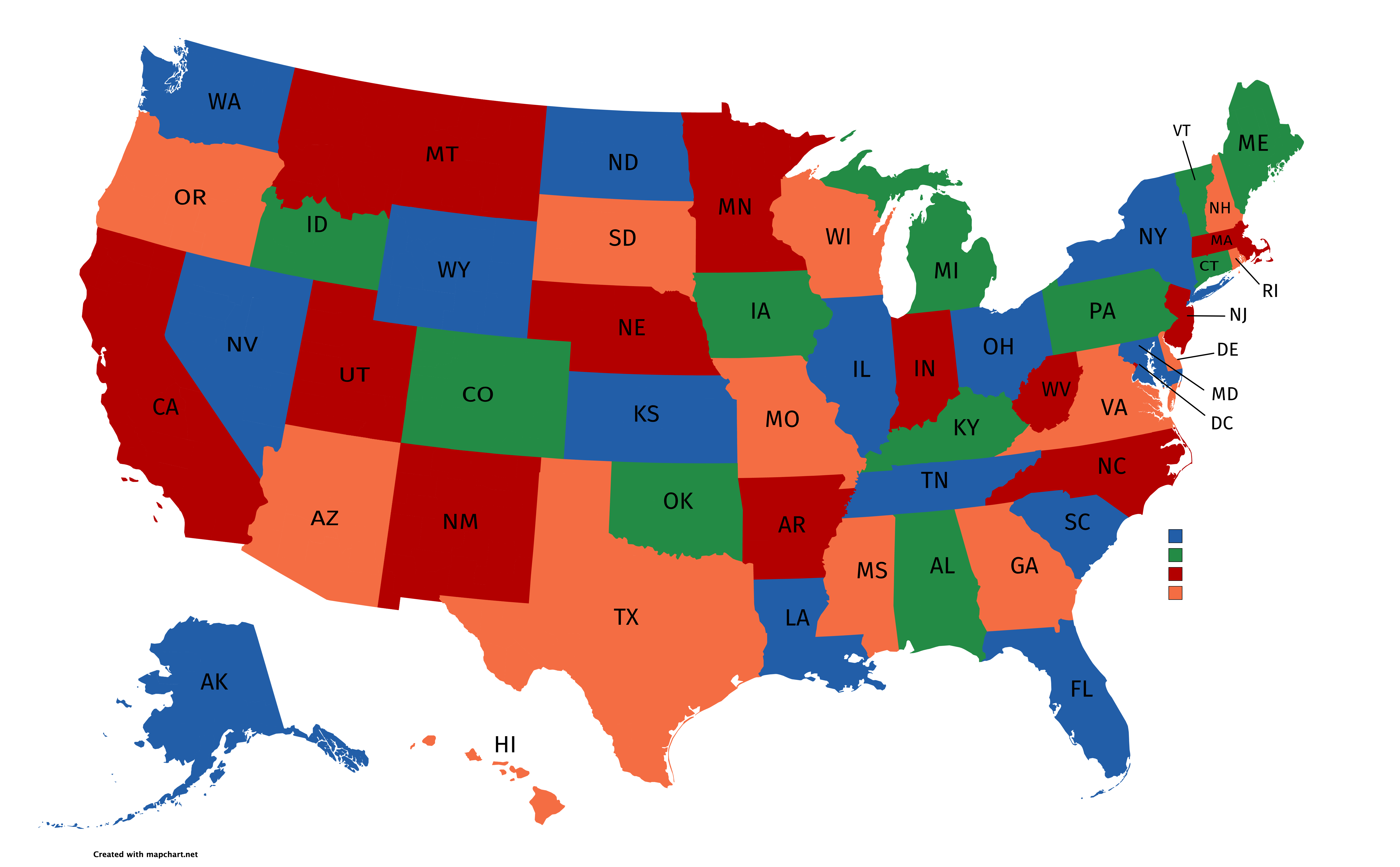
The distinctive panhandle shapes of states like Florida, Oklahoma, and Idaho aren't random quirks but the result of complex historical negotiations, political compromises, and geographical considerations that shaped America's internal borders.
When looking at a map of the United States, you might notice several states with unusual extensions or narrow strips of land jutting out from their main territory-these distinctive geographical features are called panhandles. These curious appendages aren't random accidents of cartography but the results of complex historical negotiations, political compromises, and geographical considerations that have shaped America's internal boundaries.
From Oklahoma's barren strip to Florida's Gulf Coast corridor, these panhandles tell fascinating stories about America's development. Let's explore the surprising origins of these peculiar state shapes and discover how historical accidents, political maneuvering, and even international diplomacy created these distinctive borders that persist today.
What Is a State Panhandle?
A state panhandle refers to a narrow projection of territory extending from the main body of a state, resembling the handle of a pan. These distinctive geographical features create some of the most recognizable shapes on the U.S. map. Typically, panhandles are significantly narrower than the main portion of the state and extend outward, often bordering multiple other states or bodies of water.
The term itself emerged in the 19th century, with Oklahoma's panhandle being one of the first regions described this way. Today, at least eight U.S. states have recognizable panhandles, each with its unique history and characteristics that reflect broader patterns in American territorial development.
Oklahoma Panhandle: No Man's Land
Perhaps the most iconic of all state panhandles, Oklahoma's narrow western extension has a particularly fascinating history. This 166-mile long strip exists because of the Missouri Compromise of 1820, which prohibited slavery north of the 36°30′ parallel. When Texas, a slave state, joined the Union in 1845, it couldn't maintain territory above this line.
The strip of land was effectively orphaned-too north for Texas but excluded from Kansas and Colorado for various political reasons. For over 30 years, this area was literally called "No Man's Land" or the "Public Land Strip," with no formal government or legal jurisdiction. It briefly organized itself as the unofficial Territory of Cimarron before eventually being attached to Oklahoma Territory in 1890.
Today, the Oklahoma Panhandle remains sparsely populated but is known for its agricultural production, particularly wheat farming and cattle ranching, along with growing wind energy development.
Florida Panhandle: International Negotiations
Florida's distinctive northwestern extension along the Gulf Coast emerged from international diplomacy rather than internal U.S. politics. When the United States acquired Florida from Spain through the Adams-Onís Treaty of 1819, the western boundary was set at the Perdido River.
This decision created Florida's panhandle, which extends westward from the main peninsula. The region was strategically important for the United States because it provided control over Gulf Coast ports and created a buffer zone with Spanish territories that would later become part of Alabama and Louisiana.
Today, Florida's Panhandle is home to popular beach destinations like Pensacola and Panama City Beach, as well as important military installations including Eglin Air Force Base, one of the largest military bases in the world.

Texas Panhandle: The Compromise of 1850
The Texas Panhandle exists as a direct result of the Compromise of 1850, a package of legislation that addressed territorial disputes following the Mexican-American War. When Texas joined the Union in 1845, it claimed territory extending far north into what is now New Mexico, Oklahoma, Kansas, Colorado, and Wyoming.
As part of the compromise, Texas surrendered its claims to these northern territories in exchange for $10 million from the federal government (which helped pay off the republic's debts). The northern boundary was established at the 36°30′ parallel, with an extension to the 103rd meridian creating the panhandle's distinctive shape.
The region remained sparsely settled until the arrival of railroads in the 1880s. Today, the Texas Panhandle is known for its massive cattle ranches, including the historic XIT Ranch that once covered over three million acres, and the dramatic Palo Duro Canyon, the second-largest canyon system in the United States.
Idaho Panhandle: Mining and Railroad Politics
Idaho's narrow northern extension, sometimes called the "Chimney," resulted from complex political maneuvering during the territorial period. Originally, when Washington Territory was created in 1853, much of what is now Idaho was included. The discovery of gold in the region in the 1860s led to rapid population growth and political reorganization.
Idaho Territory was created in 1863, but its borders were repeatedly adjusted. The unusual northern panhandle shape emerged because mining interests in the region had stronger economic connections to Spokane and the Pacific Northwest than to southern Idaho. Railroad magnates also influenced the boundary decisions, as they sought favorable routes for transcontinental lines.
Despite efforts by Washington to annex the region, the panhandle remained part of Idaho when it achieved statehood in 1890. Today, the Idaho Panhandle is known for its beautiful lakes, including Lake Coeur d'Alene, and remains somewhat culturally distinct from the rest of the state.
Alaska Panhandle: Russian-British Boundary Dispute
The Alaska Panhandle, or Southeast Alaska, has perhaps the most international origin story of all U.S. panhandles. This narrow strip of coastline extending southward alongside British Columbia was defined long before Alaska became part of the United States.
The panhandle's boundaries were established by the Anglo-Russian Treaty of 1825, which set the border between Russian America and British North America. Russia wanted to protect its coastal trading posts while Britain sought access to the interior fur trapping regions. The compromise created a boundary that followed a line 10 marine leagues (about 30 miles) from the coast.
When the United States purchased Alaska from Russia in 1867, it inherited this boundary, which later became a source of dispute with Canada. The final border wasn't settled until a 1903 tribunal ruling largely favored the American interpretation.
Today, the Alaska Panhandle is known for its breathtaking fjords, the Tongass National Forest (America's largest national forest), and communities like Juneau, Alaska's capital, which is only accessible by air or sea.

West Virginia's Eastern Panhandle: Civil War Division
West Virginia's Eastern Panhandle is a direct result of the Civil War and the formation of West Virginia itself. When Virginia voted to secede from the Union in 1861, delegates from western counties that opposed secession formed the Restored Government of Virginia and later petitioned Congress to create a new state.
The Eastern Panhandle counties were included in the new state partly for strategic and economic reasons-the Baltimore and Ohio Railroad ran through the region, and it was important for the Union to control this vital transportation link. Some of these counties had stronger cultural ties to Virginia than to the more mountainous western regions, but they were included in West Virginia when it was admitted to the Union in 1863.
The narrow shape of the panhandle follows the Potomac River and reflects the county boundaries that existed within Virginia. Today, the Eastern Panhandle is one of the fastest-growing regions of West Virginia, benefiting from its proximity to the Washington D.C. metropolitan area.
Nebraska Panhandle: Railroad Influence
Nebraska's Panhandle in the western part of the state was shaped largely by railroad interests and the desire to create more manageable territorial units. When Nebraska Territory was first organized in 1854, it extended all the way to the Rocky Mountains. However, as settlement pushed westward and Colorado Territory was created in 1861, Nebraska's western boundary was moved eastward to the 104th meridian.
The distinctive panhandle shape emerged because the northern boundary followed the 43rd parallel, while the southern boundary was set at the 41st parallel. This rectangular extension provided an important corridor for the Union Pacific Railroad, which played a crucial role in the settlement of the American West.
Today, the Nebraska Panhandle is known for its distinctive landscape features, including Chimney Rock and Scotts Bluff National Monument, which served as important landmarks for travelers on the Oregon, California, and Mormon Trails in the 19th century.
Maryland's Western Panhandle: Colonial Surveys
Maryland's narrow western extension, sometimes called the "Maryland Panhandle," has its origins in colonial-era surveying and border disputes. The unusual shape was determined by Maryland's original colonial charter, which granted the colony territory north of the Potomac River.
The narrow western section follows the winding course of the Potomac, creating a long, slender projection westward. This region remained relatively isolated from the rest of Maryland until the National Road (now part of U.S. Route 40) was built through the region in the early 19th century.
The most striking feature of Maryland's panhandle is that at its narrowest point near Hancock, the state is only about two miles wide. This narrowness creates unusual jurisdictional situations where travelers can pass through three states (Pennsylvania, Maryland, and West Virginia) in just a few minutes of driving.
Life in Panhandle Communities
Residents of state panhandles often develop distinctive regional identities that differ from the rest of their states. These communities frequently have stronger economic and cultural ties to neighboring states than to their own state capitals, which may be hundreds of miles away.
This geographic isolation has created unique cultural characteristics in many panhandle regions. For instance, the Florida Panhandle is often called the "Redneck Riviera" and has more in common culturally with Alabama and Georgia than with South Florida. Similarly, the Idaho Panhandle has stronger connections to eastern Washington than to Boise.
Panhandle regions also face unique challenges in terms of political representation and access to state services. Their distance from state capitals can lead to feelings of neglect, and in some cases, there have been movements to redraw state lines. For example, there have been proposals (though never successful) to separate the eastern part of Washington to create a state called "Liberty" or to attach the Oklahoma Panhandle to Texas or Colorado.
Despite these challenges, panhandle communities have often developed strong regional pride and distinctive local traditions that celebrate their unique geographical position at the edges of their states.

Frequently Asked Questions About The Fascinating History Behind 8 US State Panhandles
Which US state has the most famous panhandle?
Oklahoma's panhandle is arguably the most famous due to its distinctive shape and unusual history as "No Man's Land" - a territory without formal government for over 30 years. However, Florida's panhandle is also widely recognized and is more populated, with several major cities and beach destinations.
Why was the Oklahoma Panhandle called 'No Man's Land'?
The Oklahoma Panhandle was called "No Man's Land" because it fell into a jurisdictional gap following the Missouri Compromise. It was north of Texas (which couldn't extend above the 36°30' parallel due to slavery restrictions) but wasn't incorporated into surrounding territories. From 1850 until 1890, it had no established government, creating a lawless region where settlers had no official legal protections.
Could panhandle borders change in the future?
While theoretically possible, changing state borders in modern times would be extremely difficult. It would require consent from both state legislatures involved and approval from Congress. There have been occasional movements in some panhandles to secede and join neighboring states, but none have gained significant traction. The historical boundaries, despite their sometimes arbitrary nature, have become firmly established.
Are there any panhandles that were created for purely geographical reasons?
Most panhandles were created primarily for political rather than geographical reasons. However, Alaska's panhandle follows natural features to some extent, with the boundary set at a specific distance from the coastline. Maryland's western panhandle follows the Potomac River, using the waterway as a natural boundary. Even in these cases, though, political considerations played a major role in establishing the borders.
Do people in panhandles have different accents or cultural traditions?
Yes, panhandle regions often develop distinctive cultural characteristics due to their geographic isolation from state capitals. The Florida Panhandle has more cultural similarities with Alabama than with South Florida. The Idaho Panhandle shares more cultural traits with eastern Washington than with southern Idaho. These regions frequently develop unique dialects, food traditions, and cultural practices that reflect their position at the crossroads of different state influences.
Which panhandle was created most recently?
West Virginia's Eastern Panhandle is the most recently created, formed in 1863 when West Virginia separated from Virginia during the Civil War. The decision to include these counties in the new state was strategic, as the Baltimore and Ohio Railroad ran through the region, providing a vital transportation link for the Union forces.