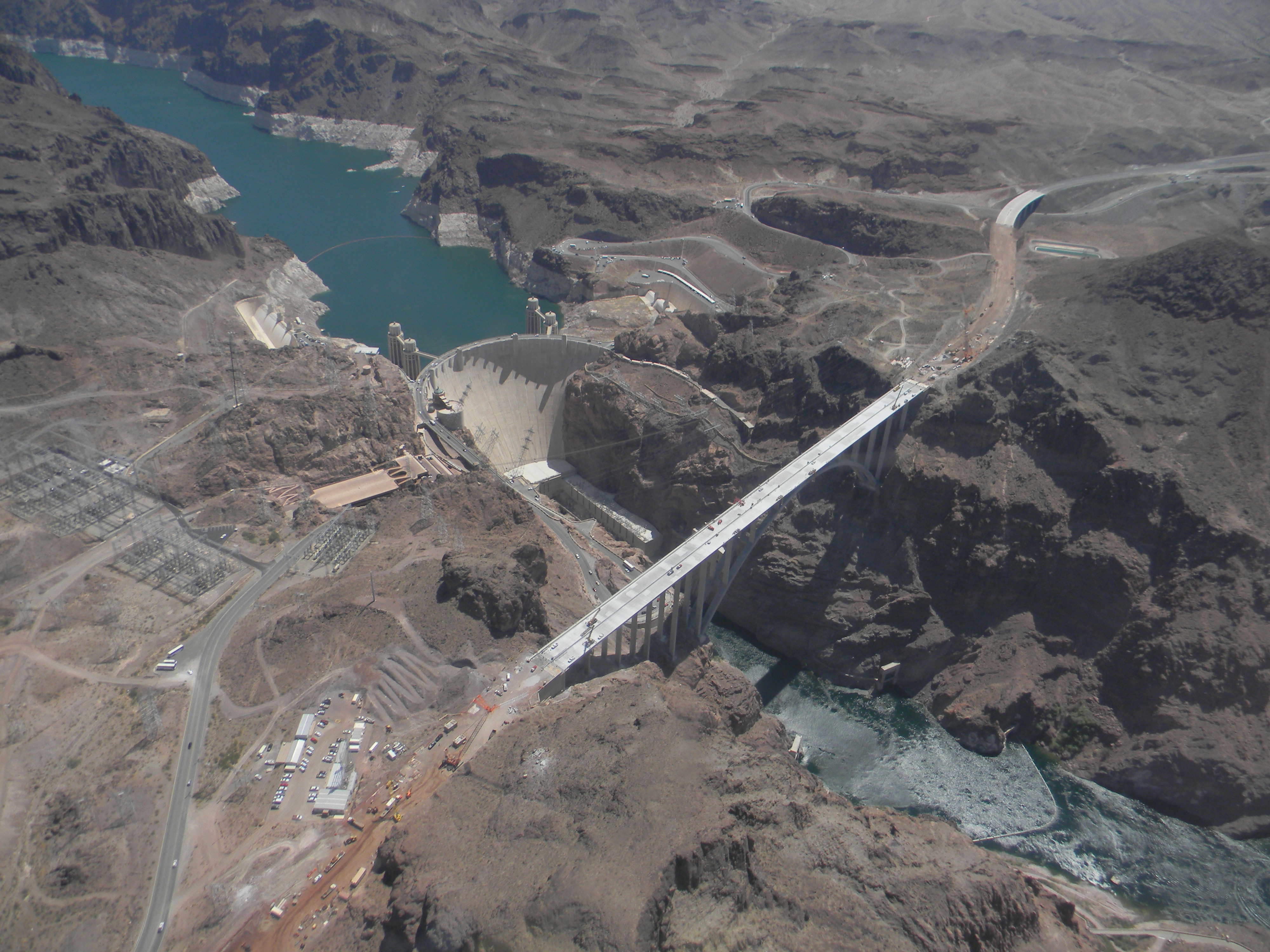
The Hoover Dam stands as one of America's greatest engineering achievements, transforming the wild Colorado River into a controlled water source that enabled unprecedented growth across the Southwest. From Las Vegas's glittering expansion to California's agricultural empire, the dam's impact extends far beyond its concrete walls.
When the last bucket of concrete was poured at the Hoover Dam in 1935, few could fully comprehend how dramatically this massive structure would reshape the American West. Rising 726 feet from the bedrock of Black Canyon, the dam represented not just a triumph over the Colorado River's unpredictable flows but the beginning of a new era for the arid Southwest. This engineering colossus would transform barren deserts into booming cities and fertile farmland, rewriting the region's future.
The Hoover Dam stands as one of the most consequential infrastructure projects in American history, fundamentally altering the environmental, economic, and social landscape of multiple states. From providing essential water and power to enabling unprecedented urban growth, its impacts continue to ripple through the region nearly a century after its completion.
An Engineering Marvel of the Depression Era
Built during the depths of the Great Depression between 1931 and 1935, the Hoover Dam represented an unprecedented engineering challenge. At a time when millions of Americans struggled to find work, the project employed over 21,000 people and required technological innovations that had never been attempted at such scale.
The dam's construction required excavating millions of tons of rock, diverting the entire Colorado River through four massive tunnels, and pouring enough concrete to build a highway from New York to San Francisco. Workers labored in extreme desert conditions, with summer temperatures regularly exceeding 120 degrees Fahrenheit. Tragically, 96 workers lost their lives during construction.
When completed, the Hoover Dam was the largest concrete structure and the largest hydroelectric power generator in the world. Its Art Deco design elements, terrazzo floors, and sculptural details reveal that this was more than utilitarian infrastructure-it was a monument to American ingenuity and perseverance during one of the nation's darkest economic periods.

Taming the Colorado River: From Destruction to Resource
Before the Hoover Dam, the Colorado River was both lifeblood and destroyer for communities along its path. Spring snowmelts regularly caused catastrophic flooding that wiped out settlements and farms, while summer droughts left the same areas desperate for water. The river's unpredictability made permanent settlement and agriculture a constant gamble.
The dam created Lake Mead, the largest reservoir in the United States when full, capable of holding nearly two years' worth of the Colorado River's flow. This transformed the river from an unpredictable force of nature into a managed resource, providing reliable water supplies year-round and eliminating the devastating flood cycles.
With the ability to store and release water as needed, the Hoover Dam allowed for precise control of downstream flow, enabling irrigation projects that would transform desert landscapes into some of America's most productive agricultural regions. The All-American Canal and Colorado River Aqueduct, both made possible by the dam's flow regulation, carried water to the Imperial Valley and Southern California respectively.
Powering the Southwest's Expansion
Perhaps equally important to water management was the dam's role in providing hydroelectric power to the developing Southwest. The Hoover Dam's power plant contains 17 main turbines generating up to 2,080 megawatts of electricity-enough to serve 1.3 million people across Nevada, Arizona, and California.
This abundant, affordable electricity helped fuel the industrial development of previously rural areas. Los Angeles, already growing rapidly, received about 25% of the dam's power output, supporting its transformation into a major industrial center during World War II and beyond. The availability of reliable electricity attracted manufacturing, processing plants, and later, technology companies throughout the Southwest.
The dam's power generation also made possible the energy-intensive water pumping systems needed to move Colorado River water uphill to population centers like Phoenix and Los Angeles. This symbiotic relationship between water and power created the foundation for modern Southwestern cities that would otherwise have been limited by local water supplies.

Las Vegas: From Desert Outpost to Metropolis
No city demonstrates the transformative power of the Hoover Dam more clearly than Las Vegas. When construction began in 1931, Las Vegas was little more than a railroad stopover with fewer than 5,000 residents. The dam project brought thousands of workers to the area, instantly creating demand for housing, entertainment, and services.
The completion of the dam provided Las Vegas with both water security and affordable electricity-two essential ingredients for desert urbanization. The city's proximity to the dam also made it a tourism gateway, as visitors flocked to see the engineering marvel. In fact, dam tourism helped establish Las Vegas's identity as a vacation destination before the casino industry fully developed.
Today, Las Vegas has grown to a metropolitan area of over 2.2 million people, with much of this expansion made possible by water allocations from Lake Mead. The city's famous fountains, golf courses, swimming pools, and even its basic municipal water supply depend on infrastructure that begins with the Hoover Dam. Without the dam's water management system, modern Las Vegas could simply not exist at its current scale.
Agricultural Transformation of the Desert
The reliable water supply created by the Hoover Dam revolutionized agriculture throughout the Southwest. California's Imperial Valley, once too arid for intensive farming, transformed into one of the nation's most productive agricultural regions, growing more than 100 different crops year-round and supplying much of America's winter vegetables.
The All-American Canal, completed in 1942 as part of the Boulder Canyon Project (which included the Hoover Dam), diverted Colorado River water controlled by the dam to irrigate over 500,000 acres of farmland. Similar irrigation projects throughout Arizona turned desert scrubland into productive cotton fields, citrus orchards, and vegetable farms.
This agricultural transformation had profound economic and demographic effects. Farm communities expanded, processing facilities were built, and transportation networks developed to move produce to markets. The year-round growing season enabled by irrigation created permanent agricultural employment, attracting workers and establishing new population centers throughout the region.

Water Rights and Regional Conflicts
The Hoover Dam's ability to store and allocate water created a need for formal agreements about who owned the Colorado River's flow. The Colorado River Compact of 1922, signed before construction began, divided the river's water between upper basin states (Wyoming, Colorado, Utah, New Mexico) and lower basin states (California, Arizona, Nevada).
These water rights became increasingly contentious as populations grew. California, with its political power and early development, initially claimed the largest share. Arizona even sent its National Guard to the river in 1934 to stop construction of a California diversion dam, and later fought California all the way to the Supreme Court over water allocations.
Native American tribes, whose water rights had been largely ignored in early agreements, began asserting their claims in the latter half of the 20th century. The Winters Doctrine, established by the Supreme Court, confirmed that tribes held senior water rights on many western rivers, including the Colorado.
Today, with climate change reducing Colorado River flows and increasing demand from growing populations, these water conflicts have intensified. The agreements that govern the river-collectively known as the "Law of the River"-continue to evolve through negotiation, litigation, and new compact agreements among the seven basin states and Mexico.
Environmental and Cultural Impacts
While the Hoover Dam brought tremendous economic benefits, it also dramatically altered the Colorado River's natural ecosystem. The dam blocked the natural silt that once fertilized downstream floodplains, changed water temperatures, and prevented native fish migration. Several species, including the humpback chub and bonytail chub, became endangered due to these changes.
The creation of Lake Mead submerged significant Native American cultural sites and ancestral lands. The Mojave, Chemehuevi, and other tribes lost access to traditional areas, including sacred sites and burial grounds. While largely overlooked during the dam's construction era, these cultural impacts have gained recognition in recent decades.
The dam also fundamentally changed the Colorado River Delta in Mexico. Once a lush, two-million-acre wetland ecosystem where the river met the Gulf of California, the delta has shrunk by 90% as upstream diversions reduced the river's flow to a trickle. International agreements now include provisions for environmental releases to partially restore these wetlands.

Legacy and Future Challenges
Nearly a century after its completion, the Hoover Dam remains central to the Southwest's water and energy infrastructure. However, the system faces unprecedented challenges. Lake Mead has been declining to record-low levels due to a combination of over-allocation, increasing demand, and reduced snowpack in the Rocky Mountains linked to climate change.
The dam's hydroelectric output has decreased as lake levels drop, reducing power generation capacity by approximately 25% during severe drought periods. Water managers have implemented shortage declarations that trigger automatic reductions in water allocations, particularly affecting Arizona and Nevada.
Despite these challenges, the Hoover Dam's legacy as a transformative force is secure. The modern American Southwest-with its major metropolitan areas, agricultural production, and economic might-exists in its current form largely because of the water and power management made possible by this structure. Cities like Phoenix, Las Vegas, Los Angeles, and San Diego owe much of their growth to the dam's resources.
As the Southwest faces a future of increasing water scarcity, the lessons of the Hoover Dam remain relevant: ambitious infrastructure can solve immediate problems but also creates new dependencies and challenges for future generations. The region's continued prosperity will depend on adapting the dam's operations to changing conditions while developing new approaches to water conservation and management.
Frequently Asked Questions About How the Hoover Dam Created Modern Southwest: 7 Transformative Effects
Why was the Hoover Dam built?
The Hoover Dam was built for four primary purposes: flood control on the Colorado River, water storage for irrigation and municipal use, hydroelectric power generation, and recreation. Before the dam, destructive floods regularly devastated communities along the river, while drought periods limited development. The project aimed to tame the river's unpredictable flows while creating water security for the Southwest's growing population.
How many states receive water from the Hoover Dam?
Seven U.S. states and Mexico receive water from the Colorado River system controlled by Hoover Dam. The Upper Basin states (Wyoming, Colorado, Utah, and New Mexico) and Lower Basin states (Nevada, Arizona, and California) all have allocated water rights under the Colorado River Compact. Additionally, a 1944 treaty guarantees Mexico an annual allocation of 1.5 million acre-feet of Colorado River water.
Did the Hoover Dam pay for itself?
Yes, the Hoover Dam has more than paid for itself. The original construction cost of $49 million (approximately $760 million in today's dollars) was completely repaid to the federal government by 1987 through revenue from power generation. The dam continues to generate approximately $100 million in power revenue annually, while providing incalculable economic benefits through water supply, flood control, and recreation.
How has climate change affected the Hoover Dam's operations?
Climate change has significantly impacted Hoover Dam operations through reduced snowpack in the Rocky Mountains, which has decreased Colorado River flows by approximately 20% since 2000. Lake Mead has dropped to historic low levels, falling below 30% capacity in recent years. This has reduced hydroelectric generation capacity, triggered mandatory water usage cuts in downstream states, and required modifications to water intake structures to maintain function at lower lake levels.
What cities would not exist without the Hoover Dam?
While technically some cities predated the dam, modern Las Vegas, Phoenix, and much of Southern California could not support their current populations without the Hoover Dam's water and power. Las Vegas particularly depends on Lake Mead for about 90% of its water supply. Cities like Henderson (Nevada), Lake Havasu City (Arizona), and numerous agricultural communities in California's Imperial Valley owe their existence or significant growth to resources made available by the dam.
Is Lake Mead expected to ever fill completely again?
Many water experts believe Lake Mead is unlikely to reach full capacity again due to climate change and overallocation of water resources. The Colorado River Basin has experienced a 23-year megadrought, with flows approximately 20% lower than the 20th century average. While wet years can temporarily increase lake levels, long-term climate projections suggest continued aridification of the Southwest. Water managers are now working on plans for sustainable operation at lower reservoir levels rather than expecting a return to historical capacity.


