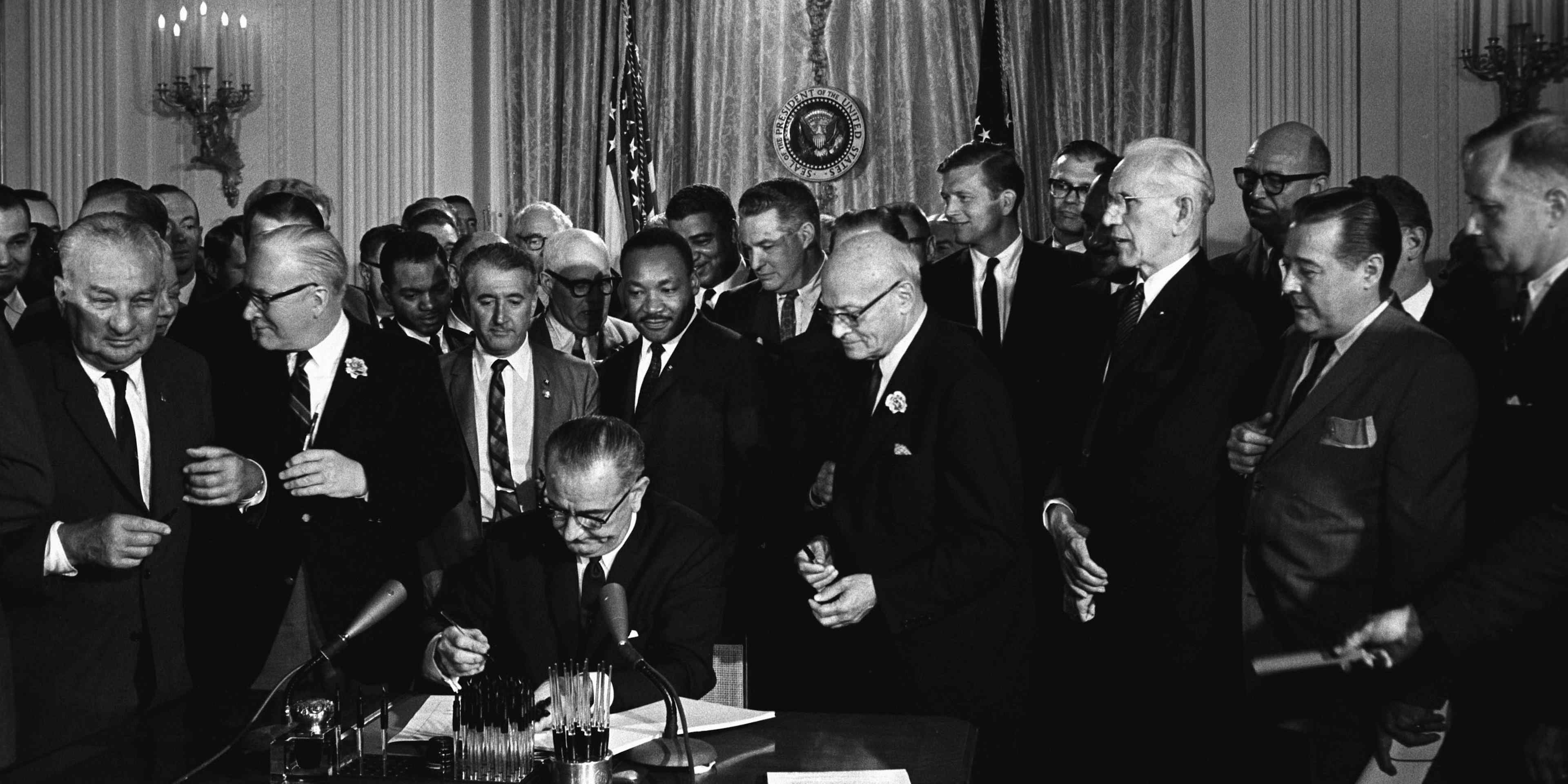
The Civil Rights Act of 1964 stands as one of America's most consequential pieces of legislation, outlawing segregation and discrimination based on race, color, religion, sex, and national origin. This landmark law fundamentally altered the social fabric of the United States and set the stage for further civil rights advances.
The Civil Rights Act of 1964 represents a pivotal moment in American history-a watershed that fundamentally transformed the nation's legal and social landscape. Signed into law by President Lyndon B. Johnson on July 2, 1964, this landmark legislation effectively dismantled the legal foundation of segregation and discrimination that had defined American society for generations.
While the law didn't immediately solve all racial inequalities, it provided powerful legal tools to challenge discrimination and set America on a new trajectory toward greater equality and justice. Its impact continues to reverberate through American society today, influencing everything from education and employment to housing and public accommodations.
Historical Context: The Road to Civil Rights Legislation
The Civil Rights Act emerged from a crucible of social upheaval and moral reckoning. The early 1960s witnessed intensifying civil rights activism, with nonviolent protests met by brutal resistance throughout the South. Powerful television images of peaceful protesters facing fire hoses, police dogs, and violent mobs shocked the national conscience.
The Birmingham Campaign of 1963, led by Dr. Martin Luther King Jr., brought national attention to segregation through strategic nonviolent protest. That same year, over 200,000 Americans participated in the March on Washington for Jobs and Freedom, where King delivered his iconic "I Have a Dream" speech.

President John F. Kennedy had introduced civil rights legislation in June 1963, but his assassination in November left the bill's future uncertain. His successor, Lyndon B. Johnson, used his political acumen and the national mood of mourning to advance what would become Kennedy's most significant legacy.
Key Provisions of the Civil Rights Act
The Act contained several titles addressing different aspects of discrimination:
Title I prohibited unequal application of voter registration requirements, though it didn't eliminate literacy tests or other discriminatory voting practices (these would be addressed by the Voting Rights Act of 1965).
Title II outlawed discrimination in hotels, motels, restaurants, theaters, and all other public accommodations engaged in interstate commerce, effectively ending the era of "whites only" establishments.
Title III prohibited state and municipal governments from denying access to public facilities on grounds of race, religion, sex, or ethnicity.
Title IV encouraged the desegregation of public schools and authorized the Attorney General to file suits to enforce this provision.
Title VII prohibited discrimination by employers on the basis of race, color, religion, sex or national origin. It also established the Equal Employment Opportunity Commission (EEOC) to address workplace discrimination.
The Political Battle: How the Act Became Law
The Civil Rights Act's passage was anything but assured. It faced fierce opposition, particularly from Southern Democrats who mounted a 75-day filibuster in the Senate-the longest in Senate history at that time.
Senate Minority Leader Everett Dirksen (R-Illinois) played a crucial role in gathering Republican support. His famous quote, "No army is stronger than an idea whose time has come," captured the historical momentum behind the legislation.

The bill finally passed the Senate on June 19, 1964, by a vote of 73-27. The House approved the Senate version on July 2, and President Johnson signed it into law that same day, just hours after House passage.
The End of Legal Segregation
The Act's impact on public segregation was swift and dramatic. "Whites Only" signs came down across the South. Restaurants, hotels, theaters, and other public accommodations that had excluded Black Americans for generations were now legally required to serve all customers regardless of race.
This transformation didn't come without resistance. Some businesses initially defied the law, and enforcement required both federal intervention and courageous individuals willing to test compliance. The Heart of Atlanta Motel v. United States Supreme Court case quickly confirmed the Act's constitutionality, ruling that Congress could regulate private businesses under the Commerce Clause.
Public school desegregation, though legally mandated by the 1954 Brown v. Board of Education decision, accelerated after the Act. The Department of Justice gained new tools to pursue integration, and federal education funding became contingent on compliance with desegregation orders.
Combating Workplace Discrimination
Title VII revolutionized American workplaces by prohibiting employment discrimination based on race, color, religion, sex, and national origin. This provision opened doors for minorities and women in previously restricted occupations and industries.
The Equal Employment Opportunity Commission was established to investigate complaints and enforce these protections. While initially lacking strong enforcement powers, the EEOC evolved to become a powerful defender of workplace rights.
Importantly, the inclusion of "sex" as a protected category-added by Congressman Howard Smith in what some believe was an attempt to derail the bill-became a cornerstone of women's rights in the workplace. This provision laid groundwork for later advances in gender equality and gave legal teeth to the growing women's rights movement.
Foundation for Voting Rights
While the Civil Rights Act's voting provisions were limited, they set the stage for the more comprehensive Voting Rights Act of 1965. The 1964 Act prohibited unequal application of voter registration requirements but didn't address many of the tactics used to disenfranchise Black voters in the South.
The continuing struggles of Black Americans to exercise their right to vote-dramatically demonstrated during the 1965 Selma to Montgomery marches-created momentum for the stronger voting protections enacted the following year.

The Ongoing Legacy of the Civil Rights Act
The Civil Rights Act of 1964 created a template for expanding civil rights protections to other marginalized groups. Subsequent legislation, including the Americans with Disabilities Act and laws protecting LGBTQ+ individuals, drew inspiration and legal precedent from the 1964 act.
The law also transformed American politics. Its passage accelerated the realignment of the two major political parties, with many Southern Democrats eventually shifting to the Republican Party in the following decades.
While discrimination hasn't been eliminated, the Civil Rights Act established the principle that discrimination has no place in American public life. It fundamentally altered national expectations about equality and created legal mechanisms to challenge ongoing discrimination.
Six decades later, the Civil Rights Act of 1964 stands as one of the most significant pieces of legislation in American history-a monument to the power of grassroots activism, moral leadership, and political courage to bend the arc of history toward justice.
Frequently Asked Questions About The Civil Rights Act of 1964: 7 Ways It Transformed American Society
Why was the Civil Rights Act of 1964 necessary?
The Civil Rights Act was necessary because legal segregation and discrimination remained entrenched throughout much of America, particularly in the South. Black Americans were systematically denied access to public accommodations, faced employment discrimination, and were excluded from many aspects of public life. Previous civil rights legislation had proved inadequate, and mounting social protest made clear that comprehensive federal action was needed to address these injustices.
Did the Civil Rights Act immediately end discrimination?
No, the Civil Rights Act did not immediately end all forms of discrimination. While it made discrimination illegal in public accommodations, employment, and other areas, enforcement was sometimes difficult and resistance was significant in some regions. The law provided legal tools to fight discrimination, but changing entrenched attitudes and practices was a slower process that continues today.
How did President Johnson get the Civil Rights Act passed?
President Johnson used several strategies to pass the Civil Rights Act. He framed the legislation as a tribute to President Kennedy's legacy after his assassination. Johnson leveraged his deep knowledge of Senate procedure and his relationships from his time as Senate Majority Leader. He built a bipartisan coalition with Republican leader Everett Dirksen, and used public sentiment following high-profile civil rights protests to create momentum for the bill.
How did the Civil Rights Act affect women's rights?
The Civil Rights Act significantly advanced women's rights through Title VII, which prohibited employment discrimination based on sex. Interestingly, the word "sex" was added to the bill by Congressman Howard Smith, possibly in an attempt to make the bill too controversial to pass. Instead, it became one of the most important legal foundations for women's equality in the workplace and paved the way for further advances in gender equality.
What was the relationship between the Civil Rights Act and the Voting Rights Act?
The Civil Rights Act of 1964 included some voting protections but focused primarily on public accommodations and employment discrimination. Its limitations in addressing voting barriers became clear as Black Americans continued to face obstacles to voting rights. This ongoing struggle, highlighted by the violence during the Selma to Montgomery marches in 1965, created momentum for the more comprehensive Voting Rights Act of 1965, which directly targeted discriminatory voting practices.
How did businesses respond to the Civil Rights Act?
Business responses varied widely. Some companies immediately complied with the new law, while others resisted. Some Southern businesses initially closed rather than serve all customers regardless of race. However, economic realities and enforcement efforts eventually led to widespread compliance. The Heart of Atlanta Motel and Katzenbach v. McClung Supreme Court cases quickly established that businesses had to comply with the law, helping to accelerate integration of public accommodations.


