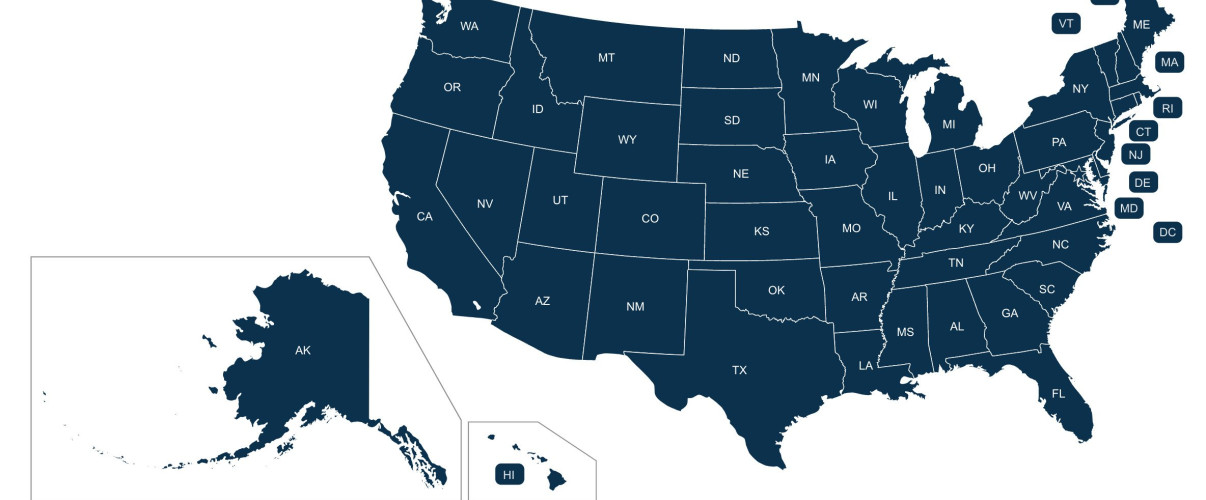
Why does Oklahoma have a panhandle? What created Maryland's bizarre shape? From surveyors' mistakes to political compromises, the stories behind America's oddest state borders reveal centuries of territorial disputes, geographical quirks, and historical accidents that shaped the nation we know today.
When you look at a map of the United States, most state borders follow rivers, mountain ranges, or straight lines drawn by surveyors. But some states have borders so peculiar that they demand explanation. These unusual boundaries weren't accidents-each one tells a fascinating story of territorial disputes, political compromises, geographical challenges, and even surveying errors that have shaped American history.
From narrow strips of land that seem to serve no purpose to perfect circles drawn with 18th-century compasses, these ten states have the most unusual borders in America. Understanding how they got their strange shapes reveals the complex negotiations, historical accidents, and geographical realities that created the nation's political map.
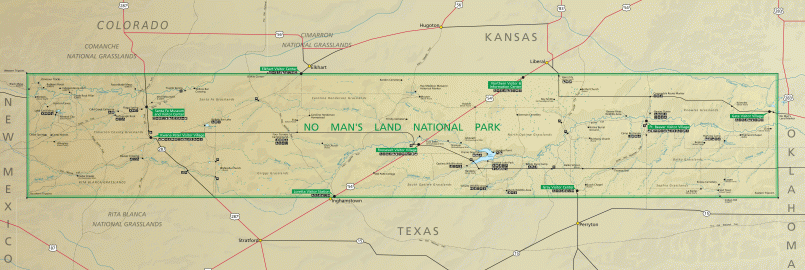
Oklahoma: The No Man's Land Panhandle
Oklahoma's panhandle is a narrow strip of land measuring just 34 miles wide and 166 miles long that extends westward from the main body of the state. This peculiar appendage exists because of a legal quirk in the 19th century that left the area literally belonging to no state or territory.
The story begins with the Missouri Compromise of 1820, which prohibited slavery north of the 36°30' parallel (except in Missouri). When Texas joined the Union in 1845, its northern boundary was set at 36°30' to comply with this restriction. Meanwhile, federal law had established that Kansas Territory would begin at the 37th parallel. This left a narrow strip of land-No Man's Land-that belonged to neither Texas nor Kansas.
For decades, this area was literally lawless territory, attracting outlaws and settlers who wanted to avoid government oversight. It wasn't until Oklahoma Territory was organized in 1890 that the panhandle was finally incorporated. When Oklahoma achieved statehood in 1907, the panhandle came with it, creating one of the most distinctive state shapes in America.
Maryland: The Chesapeake Puzzle
Maryland has one of the most bizarrely shaped borders in the nation, with the massive Chesapeake Bay cutting deep into its territory and creating a complicated jigsaw puzzle of land and water. The state's unusual shape resulted from its original colonial charter and subsequent boundary disputes.

In 1632, King Charles I granted George Calvert, the first Lord Baltimore, a charter for Maryland that described boundaries using rivers and parallels. The charter gave Maryland territory on both sides of the Chesapeake Bay, creating the Eastern Shore and Western Shore division that defines the state today.
The state's southern border with Virginia became particularly contentious, leading to disputes that weren't fully resolved until the 1877 settlement. Maryland also has an unusual notch carved out of its western territory where West Virginia intrudes northward. This resulted from the creation of West Virginia during the Civil War, when counties in western Virginia loyal to the Union broke away.
The Potomac River boundary creates another oddity: Maryland's border extends to the Virginia shore of the Potomac, meaning the entire river (up to the low-water mark on the Virginia side) belongs to Maryland-a perpetual source of jurisdictional confusion.
Michigan: Two Separate Peninsulas
Michigan is the only state in the continental United States consisting of two large separate peninsulas-the Lower Peninsula and the Upper Peninsula-that aren't even connected by land within the state's own borders. This unusual configuration resulted from a 19th-century border dispute with Ohio.
The conflict, known as the Toledo War (1835-1836), arose from competing interpretations of where Michigan's southern boundary should be drawn. The dispute centered on the Toledo Strip, a narrow band of land containing the valuable port city of Toledo. Michigan's territorial government and Ohio both claimed the area, and tensions escalated to the point where militia forces mobilized.

Congress intervened with a compromise: Ohio would keep the Toledo Strip, and Michigan would receive the Upper Peninsula as compensation. At the time, many Michiganders considered this a poor trade-the Upper Peninsula was remote wilderness with harsh winters and no obvious economic value.
History proved otherwise. The Upper Peninsula contained vast deposits of copper and iron ore that became incredibly valuable during America's industrial expansion. What seemed like a consolation prize became one of Michigan's greatest assets, though it left the state with one of the most geographically divided territories in America. Today, the two peninsulas are connected by the Mackinac Bridge, completed in 1957.
West Virginia: The State With Two Panhandles
West Virginia is the only state with two panhandles-a northern panhandle extending between Ohio and Pennsylvania, and an eastern panhandle jutting between Maryland and Virginia. This peculiar shape resulted from the state's unique formation during the Civil War.
When Virginia voted to secede from the Union in 1861, the western counties of the state-with different economic interests and fewer slaveholders-refused to go along. These counties formed their own government and eventually petitioned to become a separate state. West Virginia was admitted to the Union in 1863, the only state formed by seceding from a Confederate state.
The state's irregular borders reflect which counties chose to join West Virginia rather than remain with Virginia. The Northern Panhandle, a narrow strip only 4 miles wide at its narrowest point, includes Wheeling, which served as West Virginia's first capital. This panhandle exists because these industrialized counties along the Ohio River had strong economic and cultural ties to Ohio and Pennsylvania rather than to eastern Virginia.
The Eastern Panhandle includes counties like Jefferson and Berkeley that initially voted against joining West Virginia but were added to the new state for strategic reasons-they controlled important transportation routes and resources. This created a narrow extension reaching eastward toward the Washington, D.C. area.
Delaware: The Only Circular State Border
Delaware has the distinction of being the only U.S. state with a circular boundary line. Its northern border with Pennsylvania is a perfect 12-mile radius arc centered on the courthouse in New Castle, Delaware-a unique feature in American cartography.

This unusual border, known as the Twelve-Mile Circle, originated in a 1681 land grant from the Duke of York to William Penn. The grant described the boundary as a circle with a twelve-mile radius from New Castle. In the 1760s, the famous surveyors Charles Mason and Jeremiah Dixon (of Mason-Dixon Line fame) were hired to precisely mark this boundary.
Using 18th-century surveying equipment, Mason and Dixon created what remains the only true circular state border in the United States. They marked the arc with stone markers every mile, many of which still exist today. The technical challenge of creating a perfect curve using 1760s technology was remarkable-they had to account for the Earth's curvature and use careful triangulation.
The Twelve-Mile Circle creates unusual situations where very small portions of Pennsylvania and New Jersey fall within the arc. The border is so precise that it's still used today without modification, a testament to Mason and Dixon's surveying skills and one of the most geometrically interesting state boundaries in America.
Kentucky: The Island Cut Off by Earthquake
Kentucky has a unique geographical oddity: a small section of the state that can only be reached by land through Tennessee or Missouri. This area, known as the Kentucky Bend or "Bubbleland," exists because of one of the most powerful earthquakes in American history.
In 1811-1812, a series of massive earthquakes struck the New Madrid Seismic Zone in the central Mississippi Valley. These earthquakes, among the most powerful ever recorded in the continental United States, literally changed the course of the Mississippi River in several places. In one location, the river carved a new channel that cut off a meander, leaving a small piece of Kentucky stranded on the western side.

The Kentucky Bend covers about 10 square miles and is home to fewer than 20 residents. It remains part of Fulton County, Kentucky, but residents must travel through Tennessee to reach the rest of their state by road. There is no bridge connecting the exclave to Kentucky proper.
This isolated community creates unusual jurisdictional situations. For practical purposes, residents use Tennessee services, roads, and schools, yet they vote in Kentucky elections and pay Kentucky taxes. The area has become a curiosity for geography enthusiasts and remains one of the strangest border anomalies in the United States, all because an earthquake changed the course of a river more than two centuries ago.
Idaho: The Missing Bite
Idaho's western border appears to have a large "bite" taken out of it where the state curves around northeastern Oregon and southeastern Washington. This unusual indentation wasn't caused by natural geography but by political compromises and territorial ambitions in the 1860s.
Idaho Territory was created in 1863 and originally included what is now Montana and most of Wyoming-a massive region. As the territory was carved up, Idaho's borders became increasingly irregular. The western bite exists primarily because of the influence of the Snake River and its tributaries, which created natural divisions between different populations and economic interests.
The area where Idaho curves around Oregon was contested by settlers in northeastern Oregon who wanted better access to markets in Portland. Meanwhile, Idaho's territorial government wanted access to the same region for its agricultural potential. The compromise left Idaho with an awkward notch that gives it one of the least rectangular borders of any western state.
This unusual border also reflects the influence of mining interests. Gold discoveries in the 1860s created boomtowns throughout the region, and territorial boundaries were adjusted to keep economically linked mining districts together. The result is Idaho's distinctive profile-wide in the north, narrow in the center, and broad again in the south.
Tennessee: The 19th Century Survey Mistake
Tennessee's southern border was supposed to be a straight line following the 35th parallel, but a surveying error in 1818 created an irregular boundary that remains in dispute to this day. This mistake has led to over 200 years of cartographic confusion and occasional legal battles.

In 1818, surveyors were commissioned to mark Tennessee's southern boundary with Georgia. However, using the primitive instruments of the era, they made a significant error and placed the line about one mile south of where it should have been. This mistake wasn't discovered until later surveys revealed the discrepancy.
The error has modern consequences. In recent years, Georgia has attempted to reclaim this strip of land, which includes a small portion of the Tennessee River. Access to the Tennessee River would give Georgia additional water resources-critically important during droughts. Tennessee, naturally, has resisted these efforts to redraw the border.
The surveying error illustrates the lasting impact of 19th-century technology limitations. Unlike Delaware's Twelve-Mile Circle, which was surveyed with exceptional accuracy, Tennessee's border shows how even small errors could create permanent boundary disputes. The irregular line remains today, a testament to a mistake made over two centuries ago that neither state wants to fully address.
Texas: The Northern Extension
Texas is famous for its size, but its northern panhandle is one of its most unusual features-a large rectangular extension that gives the state its distinctive profile. This panhandle exists because of the Compromise of 1850 and Texas's unique history as an independent republic.
When Texas joined the United States in 1845, it claimed territory extending as far north as the 42nd parallel (the southern border of present-day Wyoming). These claims were based on Texas's interpretation of its boundaries as an independent nation. However, these expansive claims created conflicts with other territories and were politically controversial.
The Compromise of 1850 resolved the issue by having Texas cede its northern claims in exchange for $10 million (a huge sum at the time) to pay off its debts. The compromise set Texas's northern boundary along 36°30' north latitude and its western boundary along the 103rd meridian, creating the rectangular panhandle.

This panhandle includes important cities like Amarillo and covers an area larger than many eastern states. The region has distinct geography and economy compared to the rest of Texas, with high plains, cattle ranching, and significant oil production. Without the 1850 compromise, Texas's northern claims might have prevented several other states from forming with their current boundaries.
Wyoming and Colorado: The "Perfect" Rectangles That Aren't
Wyoming and Colorado appear to be perfect rectangles on most maps-neat, orderly shapes defined by lines of latitude and longitude. However, both states have slightly irregular borders due to 19th-century surveying limitations and the mathematical reality of mapping a sphere onto a flat surface.
Both states were created with borders defined by specific parallels and meridians. Wyoming's borders are 41°N (south), 45°N (north), 104°3'W (east), and 111°3'W (west). Colorado's borders are 37°N (south), 41°N (north), 102°3'W (east), and 109°3'W (west). These seem like simple, straight lines, but in practice, they create irregular shapes.
The problem is that meridians (lines of longitude) converge as they approach the poles. This means Wyoming and Colorado are actually trapezoids, not rectangles-they're narrower at their northern edges than their southern edges. Additionally, surveying errors in the 1870s created small irregularities. When surveyors marked the borders using 19th-century equipment, they created lines that deviate slightly from the true meridians and parallels.
Modern GPS measurements have revealed that Colorado has 697 sides rather than four, with countless tiny zigzags along its supposedly straight borders. Wyoming has similar irregularities. These imperfections are invisible on standard maps but represent the reality that even "straight" borders are products of human measurement and the mathematical complexity of mapping Earth's curved surface. Both states proudly claim their rectangular identities, even though precise measurements reveal a more complicated truth.


